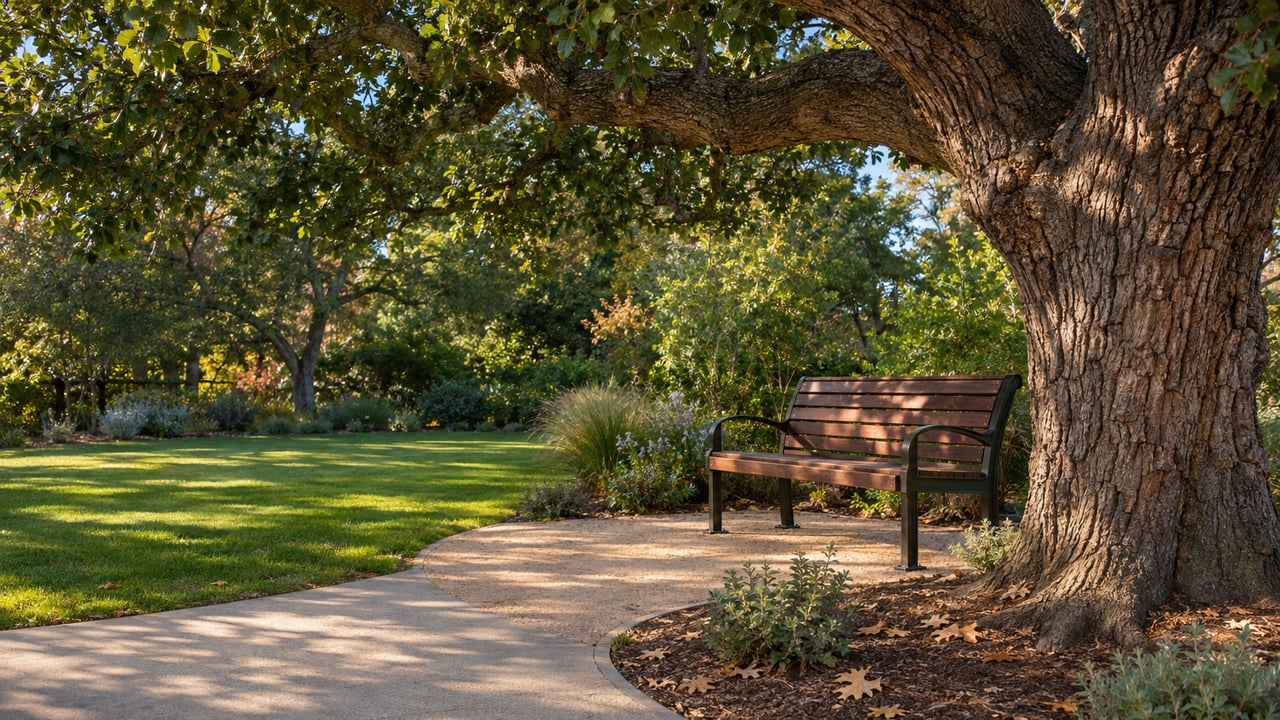
At the corner of Danville Boulevard and Jackson Way, across the street from Alamo Plaza, a heritage oak fills the center of a small park. A plaque sits at the base of its trunk. In a notice posted October 21, Contra Costa County Public Works said a contractor would prune one tree there on October 23 "in preparation for the upcoming Holiday Tree Lighting Festivities." Each December, Alamo Rotary lights that oak. The club says it organizes and helps fund the ceremony, which usually brings Santa, choruses from local schools, hot cocoa and seasonal treats from local businesses.
The tree is the main event. The plaque is the clue. Downtown Alamo has lost nearly every building its early history happened in. What marks that history now is a set of small objects along about a quarter mile of Danville Boulevard: an oak, a few plaques, a carved stump and a fiberglass horse. Most of them were put there by local organizations and individual owners, not by any government.
A Park Named for the Man Who Replanted the Boulevard
The park is Andrew H. Young Memorial Park, and its namesake had an unusually close connection to the trees on this road. The Contra Costa Times obituary reprinted by the Contra Costa County Historical Society describes Young's "Boulevard of Trees" project, which replanted dying trees along Danville Boulevard in Alamo. So the oak Rotary lights each year honors a man who spent years making sure this road had trees at all.
That obituary, dated May 24, 2002, fills in the rest of his life. He was born in Boston, the son of a clergyman. He graduated from Harvard in 1933 with a degree in economics and served in the Pacific in World War II, retiring from the Navy reserves in 1965 as a lieutenant commander. He worked 39 years for Liberty Mutual Insurance. His civic record is long. He served on the study committee whose work led to Lafayette's incorporation in 1968. He chaired the county Planning Commission in 1980 and was president of the Historical Society in 1985 and 1986. He was named San Ramon Valley citizen of the year in 1977 and Alamo citizen of the year in 1989.
"When Andy Young spoke, people listened."
The Times opened the obituary with that line. It also quoted John Henderson of the Alamo Improvement Association's planning committee: "He didn't pussyfoot around. He was very direct; he couldn't be bought off with sweet talk."
The park was open for several years before it had a formal dedication. In January 2006, Danville San Ramon reported that the plaque had already been made and that holding the dedication had become a priority. That May, the same outlet reported a ceremony scheduled for May 22, and it described Young as a voice for keeping Alamo's rural character.
Where the Buildings Went
One block south of the park, the Stone Valley Road intersection holds more recorded history than anywhere else in Alamo. None of the buildings survive. The county's Historic Resources Inventory lists what stood there and what replaced it.
| Site | Built | What happened | What stands there or marks it |
|---|---|---|---|
| Francisco Garcia adobe, northeast corner of Stone Valley Road and Danville Boulevard | 1848 | It became Alamo's first post office in 1851 and burned in 1893. August Humburg built a new home on the site around 1923, and it was sold to Safeway Stores in 1967 | San Ramon Valley Historical Society plaque for the first post office |
| Alamo School, Danville Boulevard and Stone Valley Road | Circa 1867 | Served as Alamo's first public grammar school until the 1960s. The third school building on the site was torn down | A savings and loan took the site |
| Henry's Hotel, Danville Boulevard at Alamo Square | 1854 | Built by S. Wolf & Company and managed by partner Henry Hoffman. It also housed a general store and later a saloon, and was torn down in July 1954 | A gas station took the site |
The same inventory records two more plaques a little farther afield. A wooden plaque at Danville Boulevard and El Portal marks the Union Academy, the area's first school. It was a private school built in 1860 and destroyed by fire in 1868. The Historical Society has placed another plaque at Alamo Cemetery, at El Portal Road and Lagonda Way. One recorded marker honors a tree, which suits Alamo. A plaque on Garden Estates Court marks the site where Myron W. Hall grafted the first walnut tree in the San Ramon Valley in 1872.
Every row in that table follows the same pattern. The building is gone, and the most anyone left behind is a plaque. In the stretch just south of the intersection, owners and neighbors have filled that gap themselves.
What Neighbors Put Up Instead
The building at 3194 Danville Boulevard was once Alamo's post office. It now houses a shoe repair shop, and a life-size fiberglass horse stands on top of it. John Bellandi, the building's late owner, bought the horse for $900 in 1980 and named it "Easy Keeper" because it needed so much less care than his real horses. A 2011 Danville San Ramon feature reported that the horse started out as an appaloosa and was later repainted chestnut with white socks and a white patch on its head. Some residents knew it as "Norman." Pranksters had taken it three times, and each time it came back to the roof.
Next door, at 3196, Bellandi ran Alamo Hay & Grain. A 2006 Danville San Ramon cover story reported that the site held a grocery store in the 1950s and that the feed store opened in 1962. It burned to the ground in January 1991, and more than 200 community volunteers helped rebuild it. Patch reported that the store closed in late July 2019. The building on this block that was rebuilt with volunteer help no longer sells feed. The horse on its neighbor's roof is still there.
One of the newer markers is at Orchard Court. Outside On Track Learning at 3150 Danville Boulevard, Pleasanton Weekly's October 2025 downtown cover story reported that the stump of a fallen old-growth redwood now carries chainsaw art dedicated to Robert Swedberg, the property's former owner. The county inventory also places one of Alamo's odder episodes at this corner. On August 25, 1861, a farmhand named James Smith confronted E. Van Deventer of North Alamo. Each man fired one shot, and only Smith was hit, not fatally. No plaque marks the shootout. The carved stump is the only marker on that corner.
Two Lightings Across the Street From Each Other
Alamo has a second December tree, and it stands across Danville Boulevard from the Rotary oak. Pleasanton Weekly lists the Alamo Women's Club among the tenants at Alamo Plaza. The club began in 1916 as the Alamo Mother's Club. It became the Alamo Community Club in 1935 and took its current name in 1953. According to the club's own history, the Henry family donated the site in 1949 and the clubhouse was dedicated on June 14, 1952.
In 1994 the club dedicated its Tree of Hospice Lights, thanks to member and former president Norma Scruggs. The club still holds an annual tree lighting and holiday luncheon, open to the community, in honor of people who have passed. That means the same block hosts two different December traditions. Rotary's lighting is a public party with Santa and school choruses. The Women's Club's lighting is quieter and remembers people the community has lost. Both are run by volunteer groups, like nearly everything else on this list.
A Loop for a December Evening
Taken north to south, these stops make a short walk that starts and ends near Alamo Plaza parking:
- Andrew H. Young Memorial Park, Danville Boulevard and Jackson Way. Find the plaque at the base of the oak before the lights go on.
- The northeast corner of Stone Valley Road and Danville Boulevard, where the Historical Society's plaque marks Alamo's first post office of 1851 on the Garcia adobe site.
- The Alamo School and Henry's Hotel sites around the same intersection and Alamo Square, where nothing original remains.
- 3150 Danville Boulevard at Orchard Court, for the carved redwood stump honoring Robert Swedberg.
- 3194 Danville Boulevard, where Easy Keeper stands on the roof of the old post office, next to the former Alamo Hay & Grain at 3196.
- Back north to Alamo Plaza and the Alamo Women's Club, home of the Tree of Hospice Lights since 1994.
If you want more, the Union Academy's wooden plaque at Danville Boulevard and El Portal and the Historical Society plaque at Alamo Cemetery, at El Portal Road and Lagonda Way, are a short drive away. Alamo Rotary posts details of its lighting on its community service page.
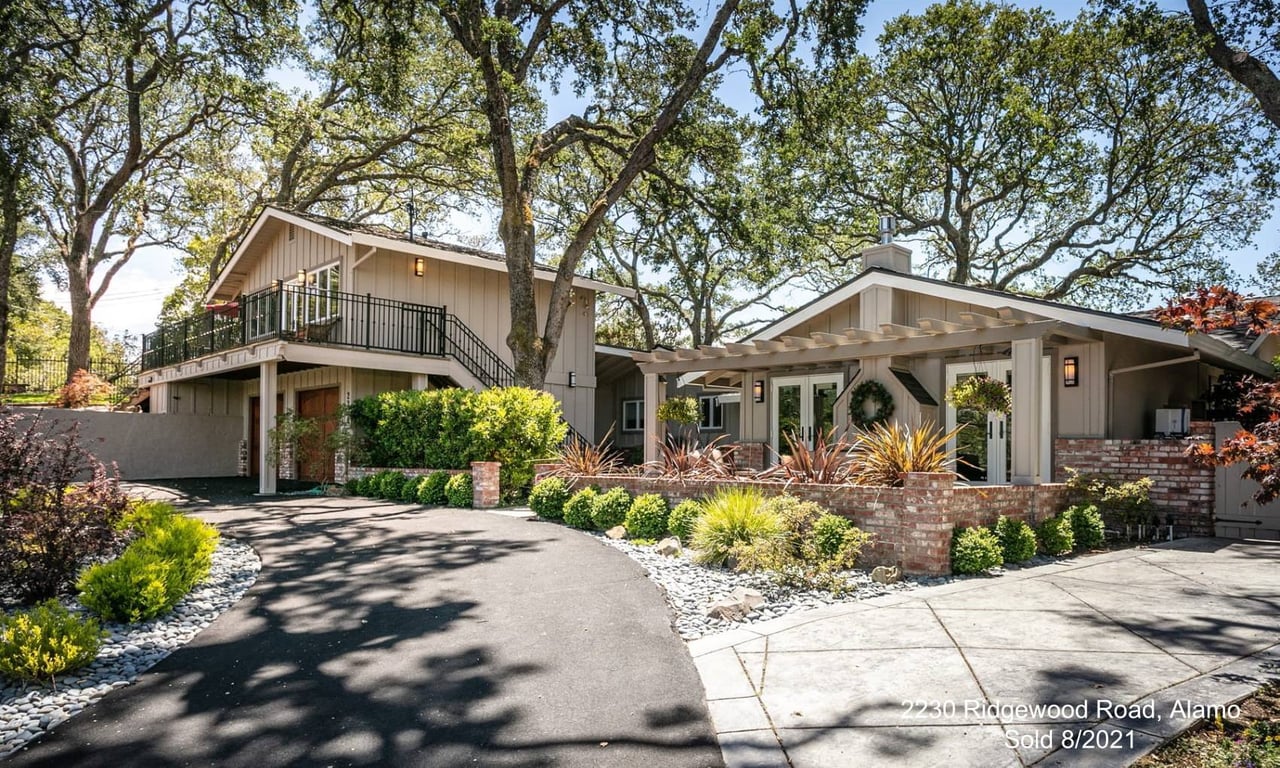
Many of the homes around these blocks have their own stories: a tree planted by a past owner, a barn that came before the subdivision, a family that has kept the same house for decades. If you are thinking about selling a home with that kind of history, Brad Gothberg can help you present it so buyers understand what they are getting. Request a Confidential Market Valuation.